
An Unassuming First Encounter
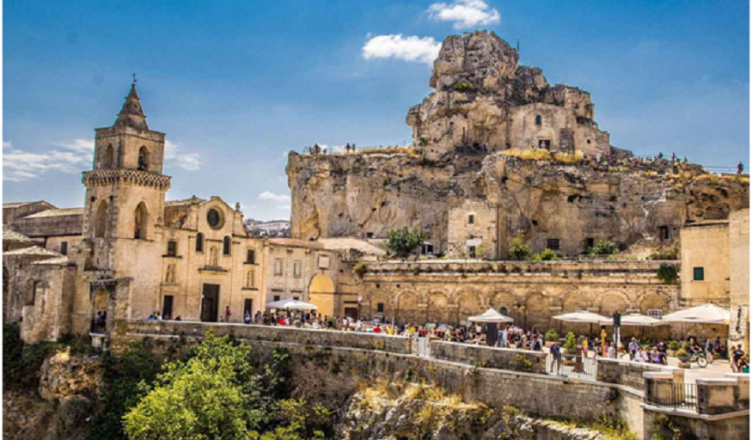
Matera does not conform to the expectations typically associated with culturally significant destinations. Its visual identity is not defined by monumental façades or theatrical urban compositions, but by a landscape that appears, at first glance, austere and even reticent. The city reveals itself gradually, resisting immediate interpretation. It is only through sustained attention that its coherence becomes perceptible. This initial restraint, rather than diminishing its impact, establishes the conditions for a more enduring form of engagement.
A City Carved from Continuity
The defining feature of Matera lies in the Sassi, an extensive network of cave dwellings excavated into limestone rock. These structures, continuously inhabited for thousands of years, form an urban environment in which architecture and geology are inseparable. Unlike cities that present history as a sequence of preserved monuments, Matera embodies a continuous habitation in which past and present coexist without clear demarcation. The absence of rupture produces a form of authenticity that is neither curated nor reconstructed, but materially embedded in the city’s fabric.
Read More : Tempo Rental in Goa: The Best Way to Travel Together During Goa Sunsplash Reggae & Valentine’s Festival
Atmosphere and Material Presence
The atmosphere of Matera emerges from the interaction between light, stone, and topography. Its visual language is minimal, yet highly expressive: surfaces are shaped by erosion and adaptation rather than ornamentation. The city’s position along a ravine introduces a dynamic relationship between elevation and perspective, allowing views to shift gradually rather than dramatically. These qualities do not impose themselves; they require observation. Over time, the repetition of forms and the modulation of light create a perceptual depth that exceeds initial impressions.
Refinement Through Adaptation
In Matera, refinement is achieved not through addition but through careful adaptation. Contemporary interventions tend to preserve the integrity of existing structures, introducing modern comfort while maintaining historical continuity. A luxury retreat in Matera is not defined by contrast with its surroundings, but by its integration into them. Such spaces reinterpret ancient dwellings without erasing their original character, allowing visitors to experience a continuity of habitation that extends beyond visual appreciation into lived experience.
Culinary Traditions as Cultural Evidence
The city’s understated character is equally evident in its culinary traditions, which reflect historical conditions of resourcefulness and endurance. Bread from Matera, for instance, is emblematic of a local culture shaped by necessity and communal practice. Its distinctive form and long shelf life are the result of techniques developed in response to environmental constraints and social organization. Engaging with such traditions provides insight into the practical realities that have informed the city’s development, reinforcing the connection between material culture and historical context.
Time as a Condition of Understanding
Matera resists rapid comprehension. Its significance is not immediately legible, but accumulates through repeated exposure. Walking through the Sassi at different times of day reveals variations in light, activity, and spatial perception. What initially appears uniform begins to differentiate into distinct zones and patterns. This temporal dimension transforms the experience of the city from observation into interpretation. The absence of overt spectacle encourages a slower, more deliberate mode of engagement, in which meaning is constructed incrementally.
Read More : Experience Himalayas, Experience Divine – Explore Nepal with Happy Outing
The Power of Restraint
Matera demonstrates that the most compelling places are not necessarily those that seek to impress. Its impact derives from restraint, continuity, and the absence of overt display. By requiring time and attention, it fosters a deeper form of understanding—one that extends beyond visual recognition into structural and cultural awareness. In this sense, Matera exemplifies a mode of experience in which significance is not immediately asserted, but gradually revealed, leaving a more durable intellectual and perceptual imprint.